
Euro Coin Advanced Features Video Preview
Posted by Albegor in Euro Coin Collection, Mobile, Software on December 5, 2025
Thanks to the feedback collectors provided in the last months, a series of new advanced features have been added to the app! 😀
They’ll be available in the next update as a subscription service.
It won’t be anything that should concern a collector who regularly takes care of his collection and demands a quality service from the app, but essential to cover development costs.
It will be like supporting your favorite creators on Patreon, for example.
Long time users of Euro Coin already know how much work went into improving it over the years, also thanks to their suggestions.
With the support through the subscription, they will be able to get an even better service, with the release of frequent updates and the development of other advanced features.
The following features are shown in the video preview, available here on YouTube:
• Variants list
• Customization of album columns
• Issuing volume data for sets
• Market value and price paid
• Multiple collection files
• Export to CSV text files
Coming soon in the last update of 2025! 😉
Gardens and Rationalism Updated
Posted by Albegor in Euro Coin Collection, Como, Giardini Lago di Como, Mobile, Rationalism Province of Como, Software on April 28, 2024
 Are you going to visit Lake Como in the north of Italy for your next holiday?
If so, then you might find useful two free apps that I developed in the past and recently updated: Gardens of Lake Como and Rationalism in the Province of Como.
With the first one you can discover the botanical gardens and parks in the areas of Como and Lecco.
The second one is an audio-guided tour to discover the Rationalist architecture buildings in the Lake Como area.
Last but not least, coin collectors already know that the app Euro Coin Collection has been updated to version 4.9 and another update is already in the works to keep the pace with the latest issues of the commemorative coins of 2024. 😉
Euro Coin Collection Update 4.8
Posted by Albegor in Euro Coin Collection, Mobile, Software on January 31, 2024
 First update of 2024 for the app Euro Coin Collection.
The first 6 2 Euro commemorative coins issued this year by Eurozone countries have been added.
Among them the Luxembourg one issued to commemorate the 100th anniversary of the introduction of the Luxembourg franc, whose design depicts the 1 franc coin in the first zero with the image of the Feierstëppler (blast furnace worker).
2024 has been added as the year of issue for the standard coins, together with the fourth French commemorative coin in the series dedicated to the Paris 2024 Olympics.
Also, the descriptions of the designs for the 2015, 2014 and 2013 commemorative coins have been improved and a Search it on… button has been added in the coin detail menu so you can easily search for them on eBay.
See you to the next update!
Euro Coin Collection Update 4.7
Posted by Albegor in Euro Coin Collection, Mobile, Software on December 28, 2023
 Last update of this year for the app Euro Coin Collection.
7 2-Euro commemorative coins issued in 2023 by the Euro-area countries have been added.
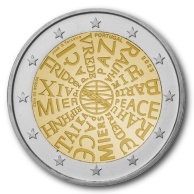
Among them, the Portuguese one dedicated to Peace among Nations, whose design depicts an armillary sphere and around it a 16-pointed star formed by the word PEACE in the 16 official languages of the 20 Eurozone countries.
Also interesting is the Vatican one, the second commemorative coin dedicated to Alessandro Manzoni, available only in precious FDC folders, in a FS Box and in a philatelic-numismatic envelope.
Also, the descriptions of the designs of the 2018, 2017, and 2016 commemorative coins have been improved, a couple of customization options requested by collectors have been added, and the mintage data has been updated.
Happy Holidays to all collectors! 🙂
Euro Coin Collection Update 4.6
Posted by Albegor in Euro Coin Collection, Mobile, Software on October 8, 2023
 Euro Coin Collection has been updated to version 4.6 for iPhone, 4.2 for iPad, 4.0 for Mac and 3.4 for Android.
The latest 6 2-Euro commemorative coins issued in 2023 by the Euro-area countries have been added.
Among them, the first Croatian commemorative dedicated to the introduction of the euro as the official currency on 1st January 2023.
A new feature debuts in this version: the ability to zoom in or out of the album with the pinch gesture, or even with the + and – keys in the Mac version.
It can be useful to give a quick look at more or less data of the album, as well as to adapt it better to the screen of your device.
Having been accustomed to a fixed size album for a long time, this new feature has a certain wow effect! 😀
Also, the descriptions of the designs of the 2021, 2020 and 2019 commemorative coins have been improved, and a usability issue related to updating the parameters of coins already present in the collection has been fixed.
The development of the app continues, stay tuned on the Facebook page of the app!
Euro Coin Collection Update 4.5
Posted by Albegor in Euro Coin Collection, Mobile, Software on July 14, 2023
 New update for the app Euro Coin Collection.
The latest 8 2-Euro commemorative coins issued in 2023 by the Euro-area countries have been added.
Among them, the belgian one dedicated to Art Nouveau, the artistic and philosophical movement characterized by a style with curved and asymmetrical lines inspired by nature, which developed between the end of the 19th century and the first decade of the 20th.
The coin depicts a decorative detail of the facade of the Hotel Van Eetvelde, an emblematic townhouse in Brussels, designed by the Belgian architect Victor Horta.
Also interesting is the coin by Greece dedicated to Maria Callas, the famous soprano of Greek origin.
Among the new features, the text Design # has been added to indicate a change of design when selecting the year of issue of standard coins. In addition, the descriptions of the designs of the 2022 commemorative coins have been improved.
A new magic feature is in development for the next update! 😉
Euro Coin Collection Update 4.4
Posted by Albegor in Euro Coin Collection, Mobile, Software on May 23, 2023
 Euro Coin Collection has been updated to version 4.4 for iPhone, 4.0 for iPad, 3.8 for Mac and 3.2 for Android.
The latest 7 2-Euro commemorative coins issued in 2023 by the Euro-area countries have been added.
Among them, the Italian one dedicated to Alessandro Manzoni, a very important writer for students of Italian literature.
His masterpiece, The Betrothed, begins with the phrase “That branch of Lake Como, which turns southwards”: it is the branch of Lecco, not far from here actually. 😉
Also interesting is the coin of Malta issued to commemorate the 550th anniversary of the birth of Nicolaus Copernicus, available only in precious divisional sets and coincards FDC.
Also improved in this update are the design of the coin detail menu, the descriptions of the 2023 commemorative coins, and the mintage data has been updated.
See you to the next one!
Euro Coin Collection Update 4.3
Posted by Albegor in Euro Coin Collection, Mobile, Software on April 30, 2023
 New features and new coins in this update of Euro Coin Collection.
6 2-Euro commemorative coins issued in 2023 by the Euro-area countries have been added.
Among them, the Italian one dedicated to the 100th anniversary of the Italian Air Force, which is being celebrated in this period with a series of events throughout Italy.
There is also the second coin dedicated to the Ukrainian people, Together with Ukraine, issued by Lithuania.
Among the new functions there is an option that allows you to view the 2 Euro commemorative coins on the Standard album, useful for those who collect divisional sets which include, for example, both the 8 regular coins and a commemorative one.
The most visible change is in the management of the collection file: a new menu allows you to view a series of general statistics and back it up thanks to the link to your Dropbox storage space.
Collectors using the Mac version will also find the HD coin designs as an optional download for both standard and commemorative coins.
The app keeps getting better thanks to the suggestions from you collectors! 🙂
Euro Coin Collection Update 4.2
Posted by Albegor in Euro Coin Collection, Mobile, Software on February 18, 2023
 Second and eagerly-awaited update for the app Euro Coin Collection.
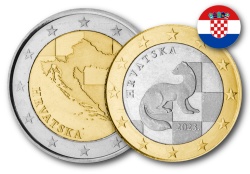
The 8 standard coins of Croatia, the new EMU member, have been added.
Croatia has chosen four designs for their national sides of the euro coins, all featuring the distinctive chequerboard pattern in the background.
The 2 Euro coin features a map of Croatia, while the 1 Euro coin shows the picture of a marten, which lent its name to the country’s former currency, the kuna.
The portrait of Nikola Tesla and the letters HR in the angular Glagolitic script are the designs of the other 6 coins.
The second commemorative of 2023 was also added, the German coin dedicated to the Elbphilharmonie in Hamburg.
Collectors using the iPhone version will also find the HD coin designs as an optional download for all the 477 commemoratives.
The next update will improve album customization and the collection file management.
Stay tuned on the Facebook page of the app to know more about them!
Euro Coin Collection Update 4.1
Posted by Albegor in Euro Coin Collection, Mobile, Software on January 29, 2023
 First update of 2023 for the Euro Coin Collection app.
5 new 2 Euro commemorative coins issued in 2022 have been added, thus completing the series of commemoratives issued last year.
Among them is the Maltese coin dedicated to the United Nations Security Council Resolution on peace and security for women, available only in precious FDC boxes and FDC coincards.
Also, 2023 was added as the year of issue for the standard coins, together with the first commemorative of 2023, the third French coin in the series dedicated to the 2024 Olympic Games in Paris.
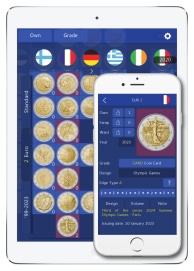
In this update, the ability to write notes for each different coin design has been added, a feature that allows for a new level of customization for your collection.
Finally, the iPhone version is now in universal format, which means it can run in fullscreen both on the iPhone and iPad.
The news for this year are certainly not over: the next update will introduce the new Euros of Croatia! 😀